
Key Takeaways
- Newsletter subscribers are warm audiences — they tend to convert to backers at a meaningfully higher rate than cold paid traffic
- Three placement types exist: Shared Feature ($250), Dedicated Feature ($500), and Solo Send ($850)
- The best time to use newsletter promotion is launch week, a mid-campaign slump, and the final 72 hours
- Newsletter promotion works best combined with paid ads — not as a replacement
- Curated newsletters with 15K–100K engaged subscribers outperform large but unengaged lists
You have launched your Kickstarter campaign. Your personal network backed you on day one. Traffic was strong for 48 hours. And then — silence. The page visits slow. The pledge count stalls. You are 40% funded with 20 days left and you are not sure where the next backers are coming from.
This is the scenario that newsletter promotion was built to solve. When you promote your Kickstarter through a curated crowdfunding newsletter, your campaign lands directly in the inbox of people who have already decided they want to discover and back new projects.
This guide explains exactly how Kickstarter newsletter promotion works, what it costs, when to use it, and how to evaluate whether a newsletter is worth the investment.
What Is Kickstarter Newsletter Promotion?
Kickstarter newsletter promotion is the practice of paying to have your campaign featured in an email newsletter sent to a list of active crowdfunding backers. The newsletter editor writes about your project — describing what it is, why it is worth backing, and linking directly to your Kickstarter page.
The key difference between newsletter promotion and paid advertising is audience temperature. A newsletter subscriber opted in. They signed up because they want to find new campaigns to back. When your project lands in their inbox, the psychological context is completely different from seeing an ad while scrolling through social media.
"Newsletter subscribers arrive at your Kickstarter page already interested in crowdfunding. They are not being interrupted — they are being invited."
The best crowdfunding newsletters maintain subscriber lists through consistent editorial quality — they curate campaigns rather than accepting every submission. This selectivity is part of what makes placements valuable. When a curated newsletter features your project, it carries implicit editorial endorsement.

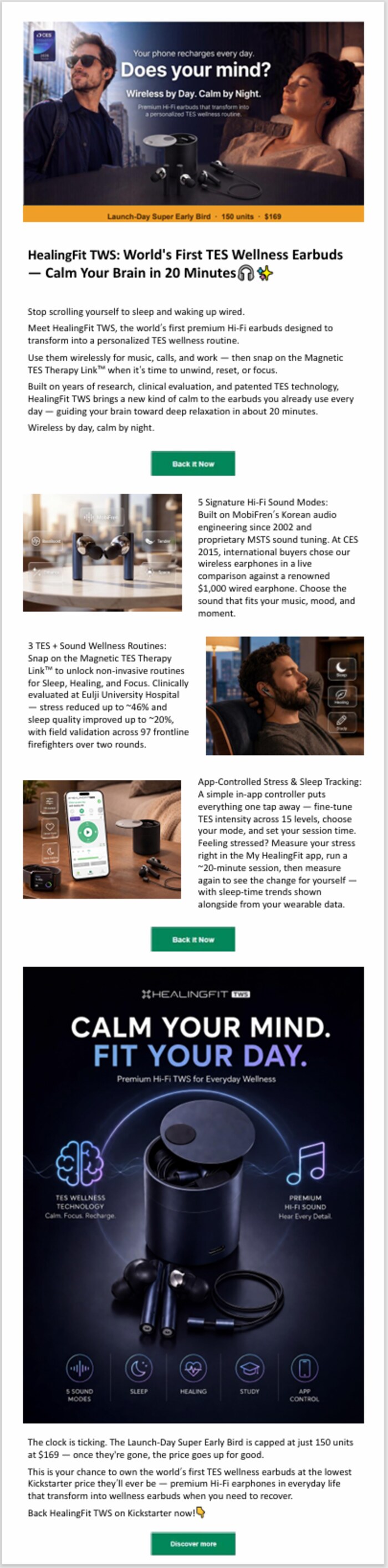
↕ scroll to see the full email — a real dedicated newsletter feature example
The Three Types of Newsletter Placements
Not all newsletter placements are the same. The three main placement types differ in reach, exclusivity, and cost.
1. Shared Feature
Your campaign is featured alongside 2–3 other curated projects in a single newsletter edition. Great for building early momentum and getting in front of a qualified audience at a lower price point.
2. Dedicated Feature
Your campaign is the sole focus of a newsletter edition sent exclusively to the subscriber list. Because the reader's full attention is on your campaign, click-through rates are significantly higher than a shared feature.
3. Solo Send (Maximum Reach)
A fully dedicated newsletter sent to the entire subscriber base — including the largest possible reach. This is the premium placement for campaigns that need saturation or are in a critical funding push.
| Placement Type | Reach | Focus | Best For | Price |
|---|---|---|---|---|
| Shared Feature | 15K subscribers | 2–3 campaigns per edition | Early momentum, testing | $250 |
| Dedicated Feature Most Popular | 15K subscribers | Your campaign only | Live campaigns needing a push | $500 |
| Solo Send | 100K subscribers | Your campaign only, maximum depth | Final push, high-value campaigns | $850 |
All three placement types above include an ROI guarantee — if the placement does not generate results that justify the cost, the team works with you to find a solution.
How Much Does Kickstarter Newsletter Promotion Cost?
The cost of Kickstarter newsletter promotion varies based on three factors: the size of the subscriber list, the exclusivity of your placement, and the editorial depth of the feature.
Cost Per Click (CPC) Benchmark
Newsletter placements to engaged crowdfunding audiences typically generate a click-through rate of 8–18%. For a list of 15,000 subscribers, a 12% CTR means 1,800 people visit your Kickstarter page. At $500 for a Dedicated Feature, that works out to roughly $0.28 per click — notably cheaper than Meta Ads or Google Ads for a warm, qualified audience.
| Placement | List Size | Est. CTR | Est. Clicks | Cost | Est. CPC |
|---|---|---|---|---|---|
| Shared Feature | 15,000 | 6–9% | 900–1,350 | $250 | ~$0.22 |
| Dedicated Feature | 15,000 | 10–16% | 1,500–2,400 | $500 | ~$0.26 |
| Solo Send | 100,000 | 8–14% | 8,000–14,000 | $850 | ~$0.08 |
Conversion Rate From Newsletter Traffic
Not all clicks are equal. Newsletter visitors from a curated crowdfunding audience typically convert to backers at a meaningfully higher rate than cold paid social traffic — meaning fewer clicks can generate more pledges.
"Newsletter traffic tends to convert at a far higher rate than cold social ads because the audience is already in a discovery and backing mindset."
↕ scroll to see the full email — a real dedicated newsletter feature example
When Should You Use Newsletter Promotion?
Timing your newsletter placement correctly makes a significant difference to the results. There are three optimal windows within a Kickstarter campaign when newsletter promotion delivers the highest ROI.
-
1Launch Week (Days 1–5)Newsletter placements in the opening days amplify your natural launch momentum, helping surface your project in "Popular" or "Trending" categories on the platform itself.
-
2Mid-Campaign Traffic Slump (Days 8–20)Most campaigns experience a significant traffic drop after launch week. A placement here injects a fresh wave of qualified traffic and creates a visible backing surge.
-
3Final 72 Hours (Urgency Push)Urgency is a powerful driver at the end of a campaign. End-of-campaign placements consistently show higher conversion because the audience knows time is running out.
Newsletter promotion works best as part of a multi-channel strategy. If your campaign page has a weak headline, unclear reward tiers, or no video — fix those first. Sending newsletter traffic to a low-converting page wastes the placement.
Newsletter Promotion vs. Paid Ads: What Is the Difference?
Founders often ask whether to spend budget on newsletter promotion or paid social ads. The honest answer is both — but they serve different roles at different stages of your campaign.
| Newsletter Promotion | Paid Social Ads | |
|---|---|---|
| Audience temperature | Warm — opted-in backers | Cold — interest-based targeting |
| Speed to results | Instant on send date | Builds over 3–5 days |
| Volume | Limited by list size | Scalable with budget |
| Trust signal | Editorial endorsement | None — ad label shows |
| Best use case | Targeted pushes, urgency moments | Sustained daily backer flow |
| Starting cost | $250 | $100–$200/day (effective) |
The most successful Kickstarter campaigns use newsletter placements for targeted traffic spikes at key campaign moments, while running paid ads in the background for consistent daily traffic. They complement each other rather than compete.
What Makes a Newsletter Placement Convert?
Securing a newsletter placement is only half the equation. The write-up and the state of your campaign page determine whether readers actually pledge.
Strong Hook in the Subject Line
The best-performing subject lines either create intrigue, state a specific outcome, or create urgency. Generic subject lines kill open rates.
Lead With the Problem, Not the Product
The write-up should open by describing the problem the product solves — not by listing its features. Readers who see themselves in the problem immediately engage.
One Clear Call to Action
Every newsletter placement should have a single, prominent link. Multiple links compete for attention — one wins every time.
Your Campaign Page Must Be Ready
Newsletter traffic arriving at a campaign with a weak main image, no video, or confusing reward tiers will not pledge. Before booking a placement, make sure your campaign page is genuinely ready to convert.
↕ scroll to see the full email — a real dedicated newsletter feature example
How to Evaluate a Crowdfunding Newsletter Before Paying
Not every newsletter that offers Kickstarter promotion is worth the investment. Before spending money, ask these questions:
- What is the list size and open rate? An open rate below 20% on a crowdfunding newsletter is a red flag. The best lists maintain 30–45% open rates.
- Is it curated or do they accept every submission? Curated newsletters carry more trust and deliver higher conversion rates.
- Can they show you past campaign results? Any reputable newsletter should be able to share performance data from previous placements.
- How was the list built? Lists built organically through genuine crowdfunding content outperform purchased lists every time.
- Do they offer any guarantee? A guarantee signals the operator is confident in their audience quality.
How Newsletter Promotion Fits a Full Campaign Strategy
Newsletter promotion is one channel in a complete Kickstarter marketing stack. Here is how it typically fits into the broader picture:
- Pre-launch: Build your own email list and run community seeding in forums. Newsletter placement books in advance for launch day.
- Launch week: Activate paid ads and newsletter placement simultaneously for maximum day-one momentum.
- Mid-campaign: Newsletter placement to break through the mid-campaign slump, while forum marketing continues in the background.
- Final stretch: A larger newsletter placement paired with retargeting ads to warm audiences and a PR push.
Campaigns that combine newsletter promotion with paid ads and PR consistently outperform those using a single channel.
Conclusion
Newsletter promotion works because it removes the hardest part of crowdfunding marketing — finding people who already understand what backing a project means. Used at the right moment, paired with a campaign page that's genuinely ready to convert, it consistently outperforms colder, more expensive channels on a cost-per-backer basis.
The three placement types exist for a reason: a shared feature lets you test the channel at low cost, a dedicated feature gives a live campaign focused attention when it needs a push, and a solo send is reserved for moments that call for maximum reach. The right choice comes down to where your campaign is in its lifecycle and how much proof of demand you already have.