
Key Takeaways
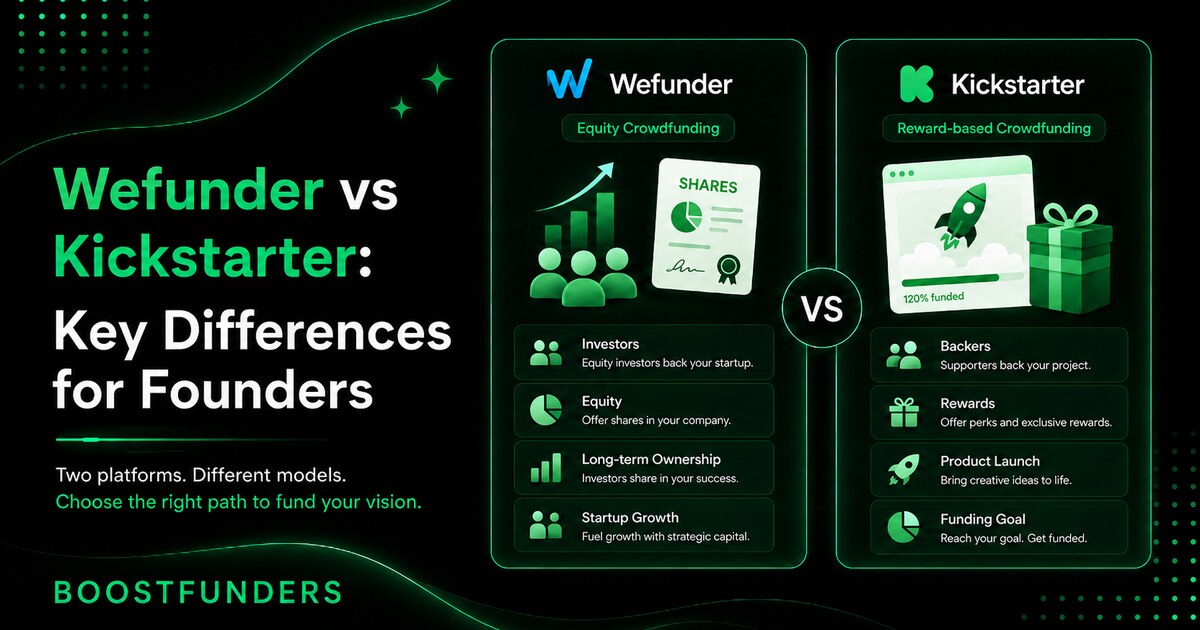
- Kickstarter is rewards-based — backers pay for a product or perk, not ownership. Wefunder is equity-based — backers become investors with a stake in your company
- Kickstarter charges roughly 5% plus payment processing on funds raised; Wefunder charges founders a success fee of around 7.5-7.9% plus ongoing admin costs
- Kickstarter is all-or-nothing with a short 30-60 day window; Wefunder raises can stay open far longer and don't require hitting 100% to close
- Wefunder involves securities compliance — Form C filings, financial disclosures, and investor caps under SEC Regulation CF
- Most founders don't have to pick one forever — a validated Kickstarter launch often becomes the proof points a Wefunder raise needs
- The right platform depends on what you're actually selling: a product people want now, or a company people want to own
"Should I run this on Wefunder or Kickstarter?" is a question we get from founders almost every week, and it usually comes from people who've only half-understood what separates the two. That's fair — from the outside, both look like a page with a funding goal, a countdown, and a "back this" button. The mechanics of the pitch look almost identical.
But underneath, they're solving two completely different problems. Kickstarter helps you pre-sell a product to people who want to own it. Wefunder helps you sell a slice of your company to people who want to own you — or at least a piece of your upside. Picking the wrong one doesn't just mean a slower campaign. It can mean months of legal prep for a raise that never should have been equity in the first place, or giving away ownership when a simple pre-order campaign would have done the job.
This guide walks through exactly how each platform works, what they cost, how long they take, and which one actually fits the stage your business is at.
What Kickstarter Actually Is
Kickstarter is a rewards-based crowdfunding platform. Backers pledge money toward a project — usually a physical product, game, film, or creative work — in exchange for the finished item or a related perk once it ships. No equity, no securities filing, no ownership stake changes hands. It's structurally closer to a pre-order system than an investment vehicle.
Campaigns run on a fixed timeline, typically 30 days, and operate on an all-or-nothing model: if you don't hit your funding goal by the deadline, no money changes hands and backers keep their cards. We go deep on how the platform's funding mechanics and discovery algorithm actually work in our complete guide to how Kickstarter really works in 2026.
What Wefunder Actually Is
Wefunder is an equity crowdfunding platform operating primarily under SEC Regulation Crowdfunding (Reg CF), with Reg A+ and Reg D options for larger raises. Instead of pre-selling a product, you're offering backers — now legally classified as investors — a financial stake in your company. That typically comes as a SAFE (simple agreement for future equity), convertible debt, revenue share, or common stock, depending on how you structure the deal.
Because real securities are involved, Wefunder raises require a Form C filing with the SEC, financial disclosures scaled to how much you're raising, and adherence to investor caps that limit how much non-accredited backers can put in based on their income or net worth. We break down the mechanics — deal structures, filing requirements, and what a raise timeline actually looks like — in our founder's complete guide to how Wefunder works.
"Kickstarter asks 'do people want this product?' Wefunder asks 'do people want to own a piece of this company?' Those are different questions, and they need different answers before you launch."
Wefunder vs Kickstarter: Full Comparison
Here's the side-by-side breakdown of the factors that actually determine which platform fits your raise.
| Kickstarter | Wefunder | |
|---|---|---|
| What backers get | A product or reward | Equity, debt, or revenue share |
| Funding model | Rewards-based | Equity / securities-based |
| Regulatory oversight | None — a platform terms of service | SEC Regulation CF / Reg A+ / Reg D |
| Campaign structure | All-or-nothing, fixed deadline | Flexible target, rolling close |
| Typical timeline | 30–60 days | 60–120+ days, longer with filings |
| Platform fee (founder) | ~5% + payment processing (3–5%) | ~7.5–7.9% of total raised |
| Minimum backer contribution | Any amount, usually reward-tiered | Typically $100 per investor |
| Legal / compliance prep | Minimal — no securities filing | Form C filing, financial disclosures |
| Best for Depends on stage | Validating and pre-selling a product | Raising growth capital for equity |
Fee figures above reflect typical published rates and change periodically on both platforms — always confirm current terms directly with Kickstarter and Wefunder before you build a budget around them.
Pros and Cons of Each Platform
Kickstarter
Pros
- No securities compliance — you can launch in weeks, not months
- Built-in discovery traffic from a large, product-hungry audience
- Validates real demand before you manufacture or scale anything
- You keep 100% ownership of your company
Cons
- All-or-nothing model means partial success still means $0
- Only works well for tangible products, not pure service or SaaS ideas
- No ongoing capital relationship — backers disappear after fulfillment
- Increasingly competitive discovery feed without external traffic
Wefunder
Pros
- Raises real growth capital instead of just pre-order revenue
- Builds a community of financially invested backers who want you to win long-term
- Lower minimum ($100) opens investment access beyond accredited investors
- No strict all-or-nothing cutoff — rounds can close on a rolling basis
Cons
- You give up equity, future control, or a revenue share permanently
- Form C filings and financial disclosures add real legal cost and time
- Annual reporting obligations continue after the raise closes
- Longer runway to close — 60 to 120+ days is common, not 30
For a deeper look at how equity-based crowdfunding compares with reward-based models more broadly — beyond just these two platforms — our equity crowdfunding vs rewards crowdfunding breakdown covers the structural tradeoffs founders run into on either path.
Fees and Costs, Side by Side
Cost is rarely the deciding factor on its own, but it does shift the math on how much of your raise actually reaches the business.
On Kickstarter, a $50,000 raise typically nets somewhere around $45,000–$46,000 after the ~5% platform fee and payment processing. On Wefunder, that same $50,000 raise nets roughly $46,000–$46,250 after the standard success fee — but add legal prep, the Form C filing, and post-close annual admin costs, and the real cost of a Wefunder raise usually runs higher than the sticker fee suggests once compliance work is factored in.
Wefunder also charges investors a separate transaction fee — typically around 2% via bank transfer or higher by card — which doesn't touch your raise directly but does affect how backers experience the platform. Kickstarter backers pay nothing beyond their pledge.
Timeline: How Long Each Platform Actually Takes
This is where the two platforms diverge the most in practice, and it's often the deciding factor for founders on a deadline.
-
1Kickstarter: prep to launchMost founders spend 4-8 weeks building the page, video, and pre-launch audience, then run a 30-day campaign. Money is typically available within two to three weeks of a successful close.
-
2Wefunder: prep to launchFinancial disclosures, Form C preparation, and legal review commonly add 4-10 weeks before a raise even goes live, depending on how much you're raising and whether you need reviewed or audited financials.
-
3Wefunder: the raise itselfBecause there's no hard 30-day cutoff, rounds commonly stay open 60-120 days, with founders actively driving traffic and updates the entire time to keep momentum from stalling.
Which One Should You Actually Use?
The honest answer depends less on which platform seems more prestigious and more on a plain question: what are you actually asking people to do — buy something, or own something?
- You have a tangible product that can be manufactured and shipped once funded
- You need market validation before committing to inventory or tooling costs
- You want to keep full ownership and aren't looking to raise growth capital yet
- You can launch and fulfill within a few months, not a multi-year buildout
- You already have traction — revenue, users, or a validated product — and need capital to grow it
- You're comfortable giving up equity or revenue share in exchange for funding
- Your business model isn't a single shippable product, like a service, platform, or subscription business
- You have the budget and runway for legal and compliance prep before launch
It's also worth reading through common failure patterns before committing budget to either path — our breakdown of 10 reasons crowdfunding campaigns fail and how to fix them applies to both reward and equity raises, and most of the failure points show up long before launch day.
Need my agency to help you with your Wefunder or Kickstarter campaign?
Choosing the right platform is only the first decision. Positioning your raise, structuring your pitch, building pre-launch momentum, and driving the right traffic at the right moment is what actually determines whether a campaign funds or stalls. Our team has run both reward-based and equity crowdfunding campaigns end-to-end — from page strategy and creative to investor or backer outreach — and we can help you decide which platform fits your business before you spend a dollar on either one.
Submit Your Project →Can You Use Both?
Yes — and a growing number of founders sequence the two deliberately rather than picking one forever. A Kickstarter campaign can validate demand, build an email list, and generate the kind of traction data — units sold, community size, repeat interest — that makes a Wefunder pitch dramatically more credible to investors later.
The reverse sequencing works too: founders who've already raised on Wefunder sometimes use Kickstarter for a specific new product line, treating it as a lower-friction way to pre-sell without touching the cap table again. If you're weighing where audience-building fits into either path, our piece on Kickstarter followers vs email lists is a useful companion read, since the audience you build on one platform rarely transfers automatically to the other.
Conclusion
Wefunder and Kickstarter aren't competing versions of the same tool — they're built to answer two different questions. Kickstarter tells you whether people want to buy what you're making. Wefunder tells you whether people want to own a piece of the company making it. Confusing the two, or picking whichever one sounds more impressive at a dinner party, is how founders end up giving away equity they didn't need to give away, or spending months on compliance prep for a campaign that only needed a product page and a launch date.
Start with what you're actually asking backers to do. If it's "buy this," Kickstarter is almost always the faster, cheaper, lower-risk path. If it's "invest in this," Wefunder gives you the legal structure and investor base to do it properly. And if you're not sure yet — that uncertainty is usually a sign you need more validation before you touch either one.