
Key Takeaways
- Newsletter promotion is worth it when the audience is genuinely opted-in crowdfunding backers — not a general subscriber list
- The most common reason newsletter promotion fails is a campaign page that cannot convert the traffic it receives
- Realistic click-through rates for curated crowdfunding newsletters range from 6–18% depending on placement type and list quality
- Newsletter promotion works best combined with other channels — not as a standalone strategy
- Always ask for open rate data, subscriber source, and past campaign results before paying any newsletter
Every Kickstarter creator eventually asks this question. You have seen newsletters offering to feature your campaign in front of thousands of active crowdfunding backers. The pricing looks reasonable. The pitch sounds compelling. But is it actually worth spending $250, $500, or $850 on a newsletter placement?
The honest answer is: it depends — and this article is going to give you a framework for knowing exactly when it does and when it does not. We run one of these services ourselves, which means we have seen the results across hundreds of placements. We are going to tell you what works, what does not, and what red flags to look for before you spend a single dollar.
What "Worth It" Actually Means for Newsletter Promotion
Before evaluating any newsletter placement, you need to be clear about what result you are actually measuring. "Worth it" means different things at different campaign stages, and a placement that underperforms by one metric may be delivering real value by another.
| Goal | Metric That Matters | When Newsletter Excels |
|---|---|---|
| Immediate pledges | Backers acquired per send | Live campaign with a converting page |
| Traffic spike | Clicks to campaign page | Any stage — newsletters are reliable for clicks |
| Algorithm boost | Kickstarter ranking movement | Launch week and mid-campaign plateau |
| Social proof | Backer count increase | Early stage when social proof is thin |
| Brand awareness | Impressions and opens | Pre-launch or awareness phase |
The most common mistake creators make is evaluating a newsletter placement purely on immediate pledges and declaring it a failure if the cost was not recovered within 24 hours. In reality, a newsletter send that generates 1,200 clicks to your campaign page may have triggered meaningful Kickstarter algorithm movement — surfacing your campaign to organic traffic that pledges over the following days — even if the direct attribution is harder to measure.
The Case For Newsletter Promotion
There are genuine, measurable reasons why newsletter promotion works when done correctly — and understanding them helps you evaluate whether a specific newsletter is actually delivering on those reasons or just selling the concept.
Audience Intent Is the Core Advantage
The fundamental difference between a newsletter placement and a paid social ad is where the audience is mentally when they encounter your campaign. A paid ad interrupts someone who is scrolling through their social feed for entertainment. A newsletter subscriber opened an email specifically because they want to discover new crowdfunding projects to back.
This difference in intent is why email marketing consistently produces higher conversion rates than most digital advertising channels. When the list is built around a specific niche — active crowdfunding backers — that advantage compounds significantly. The subscriber already understands what Kickstarter is, already knows how to pledge, and is actively looking for their next project to support.
Cost Per Backer Can Be Highly Competitive
On a well-performing newsletter placement, the cost per backer acquired is often lower than what creators achieve through cold paid advertising, particularly when accounting for the learning curve that Meta and Google Ads require before they start delivering efficient results.
According to Statista's crowdfunding research, campaigns that diversify across multiple acquisition channels — including email and newsletter marketing — consistently raise more than those relying on a single paid channel. Newsletter promotion is a meaningful part of that diversification mix for campaigns that execute it correctly.
Timing Control
Unlike paid ads that take days to exit the learning phase, a newsletter send delivers traffic on a specific, schedulable date. This means you can engineer a traffic spike precisely when you need it — launch day, mid-campaign plateau, or the final 72-hour urgency window. That level of timing control is genuinely valuable, especially for campaigns managing multiple promotional channels simultaneously.
Feature Your Campaign in Front of 100,000+ Active Backers
Our editorial team reviews every campaign personally before featuring it — which is exactly why our open and click rates stay high. ROI guarantee on all three packages.
- Shared Feature $250 — 15K subscribers
- Dedicated Feature $500 — 15K, your campaign only
- Solo Send $850 — 100K+ full list reach
The Honest Case Against: When Newsletter Promotion Does Not Work
Because we run a newsletter promotion service, it would be easy to only tell you the positive side. But the reality is that newsletter promotion fails in predictable, avoidable ways — and understanding them upfront is the difference between a placement that pays for itself and money wasted.
Your Campaign Page Cannot Convert the Traffic
This is the number one reason newsletter placements underperform. The newsletter's job is to earn the click. Once that click lands on your Kickstarter page, the newsletter's work is done — everything that happens next is determined entirely by your campaign page.
If your campaign page has a weak hero image, no video, confusing reward tiers, or a pitch that does not clearly explain what the product is and why someone should back it right now — no newsletter in the world will make that campaign fund at a rate that justifies the placement cost. Before you spend a dollar on promotion of any kind, ask yourself honestly whether a stranger landing on your campaign page for the first time would immediately understand what you are offering and want to back it.
If your campaign is currently converting at under 2% (meaning fewer than 2 out of every 100 visitors are pledging), fix the page first. Sending newsletter traffic to a weak page is expensive and demoralising. A well-optimised campaign page should convert at 3–8% from warm audiences.
The Newsletter Audience Is Not Actually Crowdfunding Backers
Not every newsletter that offers "crowdfunding promotion" has an audience of active crowdfunding backers. Some are general startup newsletters, some are tech blogs with a broad readership, and some are lists that were purchased or built through generic lead generation tactics. The word "backers" in a newsletter's pitch does not mean those subscribers have ever actually backed a Kickstarter campaign.
This is why vetting a newsletter before paying is not optional — it is essential. An unengaged list of 50,000 subscribers with a 5% open rate will produce fewer results than a curated list of 15,000 genuine crowdfunding backers with a 35% open rate.
Using Newsletter as Your Only Channel
Newsletter promotion is a spike channel — it generates a concentrated burst of traffic on a specific day. Used alone, without paid ads sustaining daily traffic, without your own email list driving personal-network pledges, and without social media maintaining visibility, a single newsletter send will produce a one-day surge followed by silence.
As our guide on how to get backers for your Kickstarter campaign covers in detail, the campaigns that fund consistently are the ones that run multiple channels simultaneously — not the ones that bet everything on a single promotion type.
What Results Should You Realistically Expect?
Setting realistic expectations before you book a placement prevents disappointment and helps you evaluate whether the results you receive are normal or a sign that something went wrong.
| Placement | List Size | Expected Open Rate | Expected CTR | Expected Clicks | Expected Backers (3% conv.) |
|---|---|---|---|---|---|
| Shared Feature | 15,000 | 28–35% | 5–8% | 750–1,200 | 22–36 |
| Dedicated Feature | 15,000 | 28–35% | 10–16% | 1,500–2,400 | 45–72 |
| Solo Send | 100,000 | 25–32% | 8–14% | 8,000–14,000 | 240–420 |
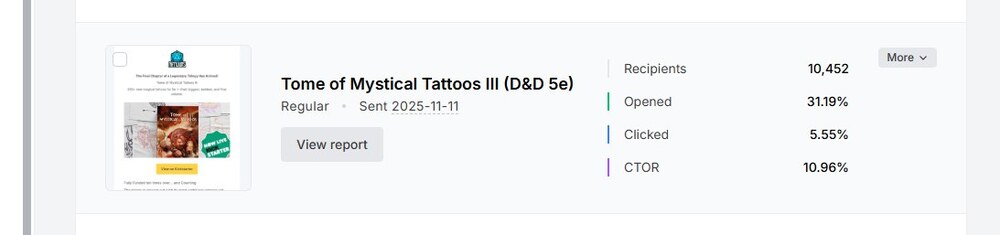
These are industry benchmarks for well-curated crowdfunding newsletters with genuinely engaged audiences. The actual results for any specific campaign will vary based on the product category, the quality of the editorial write-up, the campaign page conversion rate, and the timing of the send within the campaign window. High-visual products (gadgets, games, design items) consistently outperform text-heavy or abstract concepts in email formats.
Boostfunders Manages Your Full Campaign Marketing Stack
If you want newsletter promotion combined with paid ads, influencer outreach, PR, and email marketing all working together — that is what the Boostfunders agency was built to do.
- Pre-launch audience building and strategy
- Meta, Google, Pinterest and Reddit Ads
- Influencer and creator outreach
- PR and press distribution
- Full campaign management from launch to close
How to Evaluate Any Newsletter Before Paying
The difference between a newsletter that delivers results and one that takes your money and produces nothing comes down to five questions you should ask before committing to any placement.
Question 1: How was the subscriber list built?
A list built organically through crowdfunding content — blog posts, YouTube videos, existing campaign features — will always outperform a purchased list or a list built through generic lead generation. Ask the newsletter operator directly how subscribers joined the list. If they cannot give a clear, specific answer, that is a warning sign.
Question 2: What is the current open rate?
Open rate is the percentage of subscribers who actually open the email. According to Mailchimp's industry benchmarks, average open rates across all industries hover around 20–25%. A curated crowdfunding newsletter with an engaged audience should be achieving 28–40% consistently. Anything below 20% on a "crowdfunding" newsletter list should prompt serious questions about list quality.
Question 3: Do they curate campaigns or accept everyone?
A newsletter that accepts every submission regardless of campaign quality will train its audience to ignore the features — because the quality varies too wildly to trust. A curated newsletter that rejects poor-fit campaigns maintains editorial standards, which means subscribers trust that anything featured is worth looking at. That trust is the primary asset you are paying for. If a newsletter has never rejected a campaign, you are not buying editorial trust — you are buying a bulk send.
Question 4: Can they show you past campaign performance?
Any credible newsletter service should be able to share anonymised or aggregate performance data from previous placements. Click-through rates, approximate backers generated, campaign categories that perform well — these are the numbers that tell you whether the audience actually converts. If a newsletter cannot provide any historical performance data, treat that as a significant red flag.
Question 5: What guarantee do they offer?
A newsletter that offers an ROI guarantee is demonstrating confidence in its own audience quality. It means the operator believes their list will convert enough of your traffic into pledges to at least match your placement cost — because if it does not, they are on the hook for the difference. No serious newsletter service without a strong audience will offer this guarantee, because they would lose money constantly.
- List built organically through crowdfunding-specific content
- Open rate of 28%+ consistently verified
- Editorial curation — not every campaign is accepted
- Past campaign performance data available on request
- ROI guarantee or equivalent performance assurance included
- Cannot explain how the subscriber list was built
- Open rate below 20% on a "crowdfunding" list
- Accepts every campaign without review
- No historical performance data available
- No guarantee of any kind on results
How to Maximise Your ROI From a Newsletter Placement
Even with the right newsletter and the right audience, the results you get from a placement are heavily influenced by decisions you make before and after the send date.
Prepare Your Campaign Page Before You Submit
This cannot be overstated. Your campaign page's ability to convert visitors into backers is the single biggest variable in how a newsletter placement performs. Before submitting for a feature, check each of these:
- Hero image is high-quality and immediately communicates what the product is
- Campaign video exists and loads within the first 10 seconds
- Your funding goal and progress bar are visible and not embarrassingly low
- Reward tiers are clearly explained with realistic delivery timelines
- Your campaign pitch opens with the problem being solved, not a feature list
Choose the Right Timing
Newsletter promotion performs best at three specific moments in your campaign: launch week (to build momentum and trigger algorithmic distribution), mid-campaign (to break through the traffic plateau that almost every campaign experiences), and the final 72 hours (when deadline urgency drives conversion rates up). Booking a placement during the flat middle of your campaign with no particular urgency signal is the least efficient use of a newsletter placement.
Run Supporting Channels Simultaneously
A newsletter send that lands on the same day your social media posts go out, your personal email list receives a campaign update, and your retargeting ads are active will always outperform a newsletter send that runs in isolation. The combined signal across multiple channels reinforces credibility and creates multiple touchpoints for the same potential backer — someone who sees your campaign in a newsletter and then again in a social post is far more likely to pledge than someone who saw it once.
Track and Analyse the Results
Ask for the performance report after the send and actually read it. Compare clicks to pledges, calculate your conversion rate, and compare it against your baseline campaign page conversion rate. If the newsletter's click-through was strong but your conversion rate was low, the problem is your campaign page. If click-through was low, the write-up or subject line was the weak point. Understanding which part of the funnel underperformed tells you exactly what to improve for the next send.
"A newsletter placement is a test as much as it is a promotion. The data it generates about your campaign page's conversion rate is often as valuable as the backers it directly brings in."
The Verdict: When Newsletter Promotion Is and Is Not Worth It
Rather than a blanket yes or no, here is the clearest framework we can give you based on hundreds of placements across Kickstarter, Indiegogo, and Wefunder campaigns.
| Situation | Worth It? | Reason |
|---|---|---|
| Live campaign, strong page, launch week | Yes | Maximum timing impact + algorithm boost |
| Live campaign, mid-campaign plateau | Yes | Breaks through the traffic slump |
| Final 72 hours, urgency window | Yes | Urgency drives highest conversion rates |
| Strong campaign page but no paid ads running | Yes | Newsletter fills the traffic gap effectively |
| Weak campaign page — poor images, no video | No | Traffic will not convert — fix page first |
| Pre-launch with no existing audience | Not yet | Wait until campaign is live with some momentum |
| Using newsletter as the only promotion channel | Limited | Needs supporting channels to maximise the spike |
Conclusion
Kickstarter newsletter promotions are worth it — but not unconditionally. The channel has a genuine, structural advantage over cold paid traffic: the audience is warm, opted-in, and already in the mindset to back projects. That advantage is real, and when conditions are right, it produces results that are difficult to match through other channels at the same price point.
The conditions that need to be right are: a campaign page that can actually convert the traffic, a newsletter whose audience was genuinely built around crowdfunding, timing that aligns with a key campaign moment, and other channels running in parallel to amplify the spike. When those four things are in place, newsletter promotion earns its cost. When any of them are missing, the results will disappoint — and the fault is rarely the newsletter itself.
The smartest use of a newsletter placement is as one tool in a multi-channel campaign plan — not the whole plan. Used that way, it is one of the most cost-efficient sources of qualified backer traffic available to any Kickstarter or Indiegogo creator.