
Key Takeaways
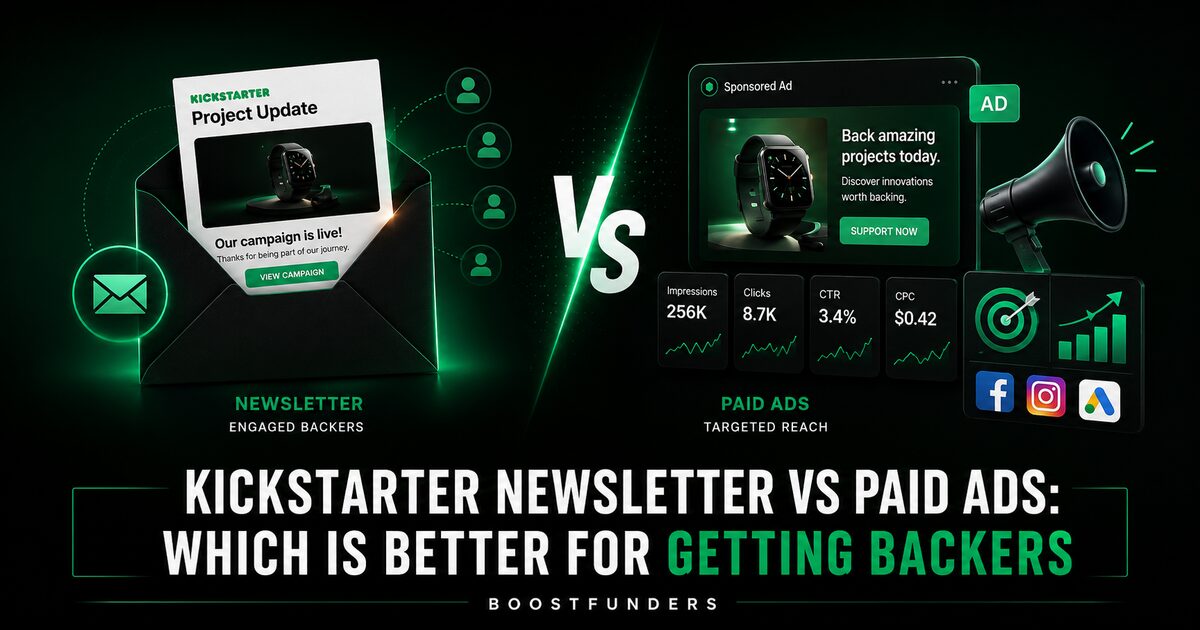
- Newsletter traffic converts at a meaningfully higher rate because the audience already opts in to discover new campaigns
- Paid ads cost more per backer on average but scale to any volume you can fund, which newsletters cannot do
- Typical paid ad costs land between $0.50–$3.00 per click and $15–$60 per acquired backer, depending on niche and creative
- Turn ads on once your page converts organic traffic at 3%+ — turning them on earlier just buys expensive data
- Pause ads when cost per pledge exceeds your average reward value, or when CTR falls below 1% for 3+ days straight
- The campaigns that fund fastest almost always run both channels together, not one instead of the other
Every founder hits this question within the first week of planning a launch: newsletter promotion or paid ads — where does the marketing budget actually go? It's a fair question, because both channels get talked about like they're the silver bullet, and both cost real money you can't get back once it's spent.
The honest answer is that they're not competing for the same job. One is built to convert warm, already-interested people fast. The other is built to manufacture volume on demand, at a cost. Neither replaces the other — but knowing when to lean on which one is the difference between a campaign that funds in week one and a campaign that limps to the deadline.
This guide breaks down what each channel actually does, what it actually costs based on real campaign data, and gives you specific, numeric signals for when to switch each one on and off.
What Newsletter Promotion Actually Does
Newsletter promotion places your campaign directly in front of a list of people who signed up specifically because they want to discover and back new crowdfunding projects. No targeting guesswork, no interruption — your project shows up in an inbox someone opted into on purpose.
That single fact — opt-in intent — is what separates newsletter traffic from every other paid channel. The reader isn't being pulled out of a scroll session by an ad; they're reading content they asked to receive, about a topic (crowdfunding) they already care about.
"A newsletter subscriber has already made the decision to be interested in crowdfunding. An ad has to make that decision for someone in three seconds or less."
We covered how this channel works in detail — placement types, pricing tiers, and exact timing — in our complete guide to Kickstarter newsletter promotion. Worth a read if you haven't seen the cost breakdown yet.
What Paid Ads Actually Do
Paid ads — mainly Meta (Facebook/Instagram) and Google — put your campaign in front of people based on interest and behavior targeting rather than opt-in intent. Nobody asked to see your ad. The algorithm decided they were statistically likely to care, and you paid for the chance to find out if it was right.
This is a fundamentally colder audience than newsletter subscribers, which is exactly why paid ads convert at a lower rate — but it's also why paid ads can scale in a way newsletters structurally cannot. A newsletter list has a fixed size. Ad spend has no ceiling except your budget and the size of the platform itself.
Newsletter promotion buys you conversion rate. Paid ads buy you volume. You rarely get both maximized from a single channel — which is exactly why the highest-funded campaigns use both, at different moments, for different reasons.
Newsletter vs Paid Ads: Full Comparison
Here's the side-by-side, covering the factors that actually matter when you're deciding where your next dollar of marketing budget goes.
| Newsletter Promotion | Paid Ads | |
|---|---|---|
| Audience temperature | Warm — opted-in, discovery mindset | Cold — interest and behavior targeted |
| Typical CTR | 8–18% | 0.9–2.5% |
| Typical CPC | $0.08–$0.28 | $0.50–$3.00 |
| Cost per acquired backer | ~$8–$20 | ~$15–$60 |
| Volume ceiling | Fixed by list size | Scales with budget |
| Speed to results | Instant on send date | 3–5 days to optimize |
| Trust signal | Editorial endorsement | None — labeled "Sponsored" |
| Setup effort | Low — booking and copy only | High — creative, targeting, testing |
| Best role Combine both | Targeted spikes at key moments | Sustained, on-demand daily traffic |
The CTR and cost numbers above are based on typical performance ranges seen across curated crowdfunding newsletters and Meta/Google ad campaigns for consumer product launches. Your actual numbers will move depending on your product category, creative quality, and how ready your campaign page is to convert — but the gap in audience temperature holds true almost universally.
Pros and Cons of Each Channel
Newsletter Promotion
Pros
- Higher conversion rate from an already-interested audience
- Lower cost per click and per backer in most cases
- Carries implicit editorial trust from the newsletter's reputation
- Simple to set up — no creative testing or targeting required
- Predictable, instant traffic spike on the send date
Cons
- Limited by the size of the subscriber list — can't scale past it
- You can't run it every day; sends are typically one-time or scheduled
- Quality varies a lot between newsletter operators — vetting matters
- Results depend partly on someone else's copywriting and placement
Paid Ads
Pros
- Scales to any volume your budget allows
- Runs continuously — daily, on-demand traffic for the full campaign
- Full control over targeting, creative, and messaging
- Retargeting lets you re-engage people who already visited your page
Cons
- Meaningfully higher cost per click and per acquired backer
- Requires ongoing testing, optimization, and creative refreshes
- Cold audience means lower trust and lower baseline conversion
- Bad early spend can burn budget before you learn what works
When to Turn Paid Ads On
Turning on ads too early is one of the most common ways founders burn budget with nothing to show for it. Ads amplify whatever conversion rate your page already has — if that rate is weak, ads just make you pay to discover that faster.
- Your page already converts organic or newsletter traffic at 3% or higher — this proves the page itself works before you pay to send it more visitors
- You have at least one creative (video or image) that's stopped scroll in organic testing — boosting a post that already got engagement outperforms cold-launching new creative
- You have budget to sustain testing for 5–7 days minimum — ad platforms need data volume to optimize; pulling out after two days wastes the learning phase
- You're heading into launch week or a mid-campaign slump — these are the two windows where paid traffic has the most to work with
-
1Validate the page firstSend a small batch of free or newsletter traffic before spending a dollar on ads. If it doesn't convert warm traffic, cold traffic won't save it.
-
2Start with a small daily budgetTest at $20–$40/day across 2–3 creative variations before scaling spend on whatever wins.
-
3Layer a newsletter placement on topRunning both during the same window compounds momentum — the newsletter spike often improves how the algorithm reads your ad's early performance too.
When to Pause or Stop Paid Ads
Just as important as knowing when to start is knowing when to stop. Continuing to run ads past their useful point is the single biggest way founders quietly drain budget in the final stretch of a campaign.
- Cost per pledge exceeds your average reward value — if you're spending $45 to acquire a backer pledging $35, the math no longer works
- CTR drops below 1% for 3+ consecutive days — this signals creative fatigue; the audience has seen the ad too many times
- You're past 90% funded with organic momentum climbing — urgency and social proof usually finish the job cheaper than paid spend can
- Frequency (times seen per person) climbs above 3–4 — you're now paying to re-show the same ad to the same tired audience
A useful habit: check cost-per-pledge daily, not weekly. Crowdfunding ad performance can shift fast, and a channel that was profitable on day 3 can flip unprofitable by day 8 as the initial audience saturates.
How They Work Better Together
The strongest funding curves we see rarely come from a single channel. They come from stacking a newsletter spike on top of a steady paid ad baseline — the newsletter creates a concentrated burst of warm, high-converting traffic, while ads keep a lower, steady stream running in the background every single day.
| Phase | Primary Channel | Supporting Channel |
|---|---|---|
| Launch week (Days 1–5) | Newsletter placement + paid ads together | Own email list, community seeding |
| Mid-campaign (Days 8–20) | Paid ads, steady daily budget | Newsletter placement to break the slump |
| Final 72 hours | Newsletter urgency send | Retargeting ads to warm visitors only |
Notice the final stretch leans on retargeting rather than cold ads — by day 25+ of a campaign, your remaining upside usually sits with people who already visited but didn't pledge, not with brand-new cold audiences.
If you're still deciding which platform your campaign belongs on in the first place, our breakdown of how Kickstarter's algorithm and funding mechanics actually work in 2026 is a useful starting point before you allocate ad budget anywhere.
And once your campaign is live and gaining traction, ranking well inside Kickstarter's own discovery surfaces matters just as much as external traffic — see our guide on how to rank higher and trend faster on Kickstarter for how the two work together.
Conclusion
Newsletter promotion and paid ads aren't rivals competing for the same budget line — they're tools built for different jobs. Newsletter placements convert better because the audience already wants to be there. Paid ads scale further because there's no list size capping how much traffic you can buy.
The founders who fund fastest don't pick one and ignore the other. They use newsletter placements to create concentrated spikes at the moments that matter most — launch week, the mid-campaign slump, the final urgency push — while running paid ads as a steady background channel, watched closely enough to know exactly when to scale up and when to pull back. Get the sequencing right, and the two channels compound each other instead of just adding up.