
Searching for a Kickstarter marketing agency can feel overwhelming. There are dozens of services with similar-sounding names, overlapping promises, and wildly different price points. Some sound like they do everything. Others focus on one specific channel. And many make claims — "guaranteed backers," "funded in 30 days," "we scaled this campaign to $2 million" — that are either impossible to verify or are technically true in ways that have nothing to do with your campaign.
This guide cuts through that. It explains what agencies in this space actually do, which of those services solve real problems for creators, how to evaluate any agency before spending money, and how to figure out whether your campaign actually needs one at all.
I am going to be direct about where individual services — including the newsletter promotion we offer at Boostfunders — fit within a broader agency picture, and where they do not. The goal is to help you make an informed decision, not to sell you something you do not need.
Key Takeaways
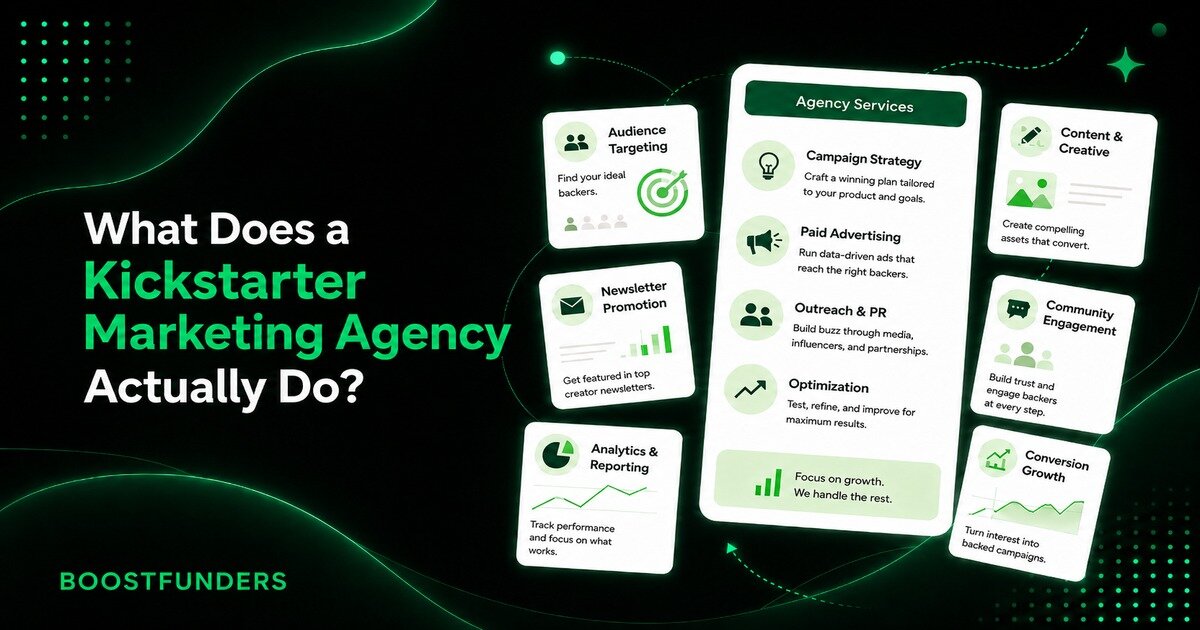
- A Kickstarter marketing agency can manage paid ads, PR, newsletter promotion, influencer outreach, community building, email marketing, and post-campaign support — not every creator needs all of them
- The best agencies specialise in crowdfunding specifically — general digital marketing experience does not automatically translate to Kickstarter results
- Not every campaign needs a full-service agency — individual services like newsletter promotion or paid ads can be more cost-effective for smaller campaigns
- Vague promises and guaranteed backer numbers are red flags — legitimate agencies talk about reach, audience quality, and process, not guaranteed outcomes
- Ask for verifiable past campaign results before committing to any agency relationship
- Timing matters — involving an agency too late in the campaign lifecycle reduces what they can actually do for you
The Core Services a Kickstarter Marketing Agency Provides
Most agencies that describe themselves as Kickstarter or crowdfunding marketing specialists offer some combination of the following services. Not all agencies offer all of them, and the quality of execution varies significantly from one to the next.
Paid advertising management
This is usually the largest component of a full-service agency engagement. Running paid ads for a crowdfunding campaign is genuinely different from running ads for an e-commerce store or a SaaS product. Kickstarter campaigns have a fixed deadline, which changes how you structure and optimise campaigns. Audiences need to be pre-warmed in some cases (particularly for higher-priced rewards). And Kickstarter-specific tracking — connecting ad spend to actual pledge revenue — requires setup that most standard paid ad agencies do not have experience with. According to Kickstarter's own published statistics, over 250,000 projects have been successfully funded on the platform, which gives experienced agencies meaningful historical data to benchmark campaign performance against.
A good crowdfunding agency will manage Meta (Facebook and Instagram) ads and often Google ads, with creative development, audience targeting, and ongoing optimisation during the campaign window. They will also typically run retargeting campaigns targeting people who visited the campaign page but did not pledge — which is often where the highest-ROI ad spend goes. Meta's own interest-based and behaviour targeting tools allow agencies to reach audiences defined by crowdfunding interests, previous backer behaviour, and lookalike profiles built from existing pledgers.
Newsletter and email promotion
Newsletter placement involves getting your campaign featured in curated crowdfunding email newsletters sent to opted-in backer audiences. This is different from managing your own email list — it is placing your campaign in front of someone else's established subscriber base.
Some full-service agencies include newsletter placement as part of their package. Others refer clients to specialist newsletter services. At Boostfunders, newsletter promotion is our primary service — which means campaigns come to us specifically for that channel rather than as part of a broader agency engagement. You can read a full breakdown of how this channel works in our Kickstarter newsletter promotion guide.
PR and media outreach
PR for a crowdfunding campaign means pitching journalists, bloggers, and online publications that cover your product category, with the goal of earning editorial coverage that sends traffic to your Kickstarter page. A funded campaign announcement with strong visuals can generate press in niche publications and sometimes in mainstream tech or lifestyle media, depending on the product. Publications like TechCrunch, The Verge, and category-specific blogs actively cover crowdfunding campaigns with unique products and strong stories — but only when the pitch is genuinely newsworthy, not just promotional.
PR is valuable when it lands but unpredictable as a channel. A placement in a major publication can send thousands of visitors in a single day. Most outreach efforts, however, go unanswered. Agencies with strong existing media relationships in your category deliver meaningfully better results than those doing cold outreach without prior connections.
Influencer and creator outreach
This involves identifying YouTube creators, Instagram accounts, TikTok creators, and niche community influencers whose audiences match your product category, and coordinating paid or organic coverage of your campaign. For games, tech gadgets, and lifestyle products in particular, a single video review from a creator with a highly engaged niche audience can drive more qualified traffic than a month of paid ads.
The challenge is that influencer outreach at the individual campaign level is time-intensive and results are variable. Agencies with an existing network of creators in your category — and track record of successfully coordinating campaign coverage — are considerably more effective than those doing cold influencer outreach for the first time on your budget.
Community and forum marketing
This means building presence and driving organic engagement in the communities where your target backers spend time — Reddit communities like r/kickstarter, niche Discord servers, Facebook groups, BoardGameGeek for tabletop campaigns, and product-category forums. Done well, this is one of the highest-conversion traffic sources available because the visitors arrive with full context and community credibility behind the recommendation.
Done badly — with spammy posts that read like ads — it results in bans and damages the campaign's reputation in the communities that matter most. An agency handling community marketing needs to understand how to engage authentically in specific communities, not just post links.
Social media management
Managing campaign social media accounts across Instagram, TikTok, X (Twitter), and Facebook during the campaign window — creating content, running polls, posting backer updates, and engaging with comments and messages. For campaigns with strong visual products or a compelling behind-the-scenes story, consistent social content can build a meaningful secondary traffic source and strengthen backer confidence.
Campaign page optimisation
Some agencies offer campaign page review and optimisation — evaluating the campaign image, video, copy, reward tiers, and overall page structure before or during the campaign, and making specific recommendations to improve conversion. This is one of the most underrated services in the category, because a campaign page that does not convert well wastes every dollar spent on traffic generation.
Email marketing and backer communication
This covers managing your own email list — building a pre-launch sign-up audience, sending launch-day emails, crafting backer update emails during the campaign, and running post-campaign follow-up sequences. Agencies that offer this service typically handle the strategy, copywriting, and send scheduling. For campaigns with an existing customer base or community, this channel can be among the highest-converting available.
Post-campaign support
A less commonly discussed but genuinely valuable service: help with the period after a campaign closes. This includes transitioning to Indiegogo InDemand or direct pre-orders, managing backer communications, coordinating with fulfilment partners, and running ongoing marketing for the product after the campaign ends. The creators who build long-term businesses from their Kickstarter success rather than just shipping a one-time product almost always have ongoing marketing infrastructure in place.
Do You Actually Need a Full-Service Agency?
The honest answer is: probably not for a first campaign, and not always even for larger ones.
A full-service agency engagement typically costs between $2,000 and $10,000+ per month depending on the scope, the ad budget being managed, and the agency's reputation. For a campaign with a $20,000 goal, that spend may not be proportionate. For a campaign targeting $200,000 or more, it often is.
The question to ask is not "should I hire an agency?" but "which specific promotion problems do I have, and what is the most cost-effective way to solve them?" Research from Shopify's crowdfunding resources consistently highlights that the most successful campaigns combine multiple traffic sources rather than relying on any single channel — which is exactly the decision framework an agency relationship should help you build, not replace.
| Campaign Situation | Best Approach | Why |
|---|---|---|
| First campaign, goal under $30K | Individual services | Newsletter + community outreach is more cost-effective than full-service retainer |
| Campaign with $50K–$200K goal | Selective services | Paid ads + newsletter + PR, managed separately or via a light-touch agency |
| Ambitious campaign, $200K+ goal | Full-service agency | Multi-channel coordination justifies the management overhead and cost |
| Campaign stalling mid-run | Newsletter + paid ads | Fastest warm-traffic injection without a long agency onboarding process |
| Creator with existing audience | Email + community | Your own list and community outreach will outperform any cold channel |
Many creators find that combining two or three well-chosen individual services — a newsletter placement, a focused paid ad campaign, and community engagement — delivers stronger results than a full-service retainer, because the money goes directly into execution rather than agency overhead.
Red Flags to Watch For When Evaluating Any Agency
The crowdfunding marketing space has a meaningful number of services that make impressive claims and deliver disappointing results. These are the patterns that consistently indicate an agency or service is not what it presents itself as.
Guaranteed backer numbers
No legitimate marketing service can guarantee a specific number of backers. Backers are real people making real decisions — no agency controls those decisions. Services that promise "500 backers guaranteed" or "we will fund your campaign" are either delivering fake engagement or setting expectations they know they cannot meet. This is one of the most reliable red flags in the category.
No verifiable past results
Any agency worth working with should be able to show you verifiable evidence of past campaign results — not just quotes and logos, but specific campaigns with outcomes you can look up. If an agency cannot or will not provide this, the absence of evidence should be treated as evidence of absence. Asking "can you show me the Kickstarter pages of campaigns you have promoted?" is a simple and effective filter.
Generic digital marketing experience with no crowdfunding specialisation
Running ads for a Kickstarter campaign is not the same as running ads for an e-commerce store. The deadline structure, the pledge psychology, the backer journey from discovery to commitment — these are different from standard purchase funnels, and agencies without specific crowdfunding experience often apply standard e-commerce frameworks that underperform. Ask specifically about crowdfunding campaigns they have worked on, not just digital marketing experience generally.
No clarity on what is and is not included
Vague service descriptions are a warning sign. If an agency tells you they will "handle your marketing" without specifying exactly which channels, what deliverables you will receive, how results will be measured, and what happens if results fall short — you do not have enough information to make a good decision. Legitimate agencies are specific about scope because they know what they are actually going to do.
Upfront payment for long commitments with no performance component
Long-term contracts that require significant upfront payment before any results are demonstrated, with no performance-linked component, put all the risk on you. Agencies confident in their work are typically willing to structure agreements that include some performance incentive or at minimum a shorter initial engagement period before committing to a longer term.
"Ask any agency for the Kickstarter URLs of campaigns they have promoted. If they hesitate, that tells you everything you need to know."
Questions to Ask Before Hiring Any Kickstarter Marketing Agency
-
1Can you share verifiable past campaign results?Ask for specific campaign URLs and the results achieved. "We helped a tabletop game raise $180,000" is meaningful if you can look up that campaign and confirm it. A logo on a case studies page without verifiable specifics is not.
-
2Which specific channels will you manage and what does each one include?Get a written breakdown of exactly what is included in the scope. If paid ads are included, ask for the ad budget management process, reporting cadence, and what happens when an ad set underperforms. Vague answers here are a warning sign.
-
3How do you measure results and what will you report?Ask what data you will receive and when. Tracked links, pledge attribution, ad performance reports, and newsletter click data are all standard deliverables from reputable services. If the answer is "we will keep you updated," push for specifics.
-
4What happens if results fall short of expectations?Does the agency offer any performance guarantee, refund provision, or additional support if results do not justify the spend? The answer to this question tells you how confident they are in their own work.
-
5What do you need from me, and when?Good agencies have clear onboarding requirements — campaign assets, access to ad accounts, campaign URL, product information. If an agency is vague about what they need from you to get started, they may not have a clear process. Clarity here signals professionalism.
-
6What is your experience specifically with my product category?An agency that has promoted twenty tabletop game campaigns understands the backer community, the seasonal rhythms of the category, and the influencers who matter. An agency that is doing their first game campaign may have strong general skills but lacks that category-specific advantage.
When to Bring in an Agency — and When It Is Too Late
Timing is one of the most underappreciated factors in agency relationships for crowdfunding campaigns. Bringing in an agency six weeks before launch gives them time to build pre-launch audiences, run warm-up ad campaigns, coordinate PR timing, and prepare newsletter placements for day one. Bringing them in two weeks into a live campaign limits what they can realistically do.
For paid advertising specifically, the first three to five days of any Meta campaign are spent gathering data before meaningful optimisation can happen. If your campaign only has ten days left when you bring in a paid ads team, they are spending a third of your remaining campaign time in the learning phase before results actually improve.
The ideal engagement timeline looks like this:
- 8–12 weeks before launch: Strategy, page review, creative development, pre-launch audience building, newsletter booking, influencer outreach begins
- 4 weeks before launch: Pre-launch paid ads to build a warm retargeting audience, community engagement begins, PR pitching starts
- Launch week: All channels active simultaneously — newsletter send, paid ads fully running, PR follow-ups, social posting, community updates
- Mid-campaign: Optimise paid ads, newsletter placement for momentum push, influencer content going live
- Final stretch: Urgency-led messaging across all channels, final newsletter placement, retargeting at maximum spend
If you are reading this mid-campaign and looking for help right now, the most practical options are those that can activate quickly — newsletter promotion (which can go live within 24–72 hours of submission) and paid retargeting ads (which can be set up in a day or two). A full agency onboarding process in the middle of a live campaign is rarely the right move. For an immediate action plan, this guide on promoting a stalling live Kickstarter is the right starting point.
What Does a Kickstarter Marketing Agency Cost?
Pricing in this space is genuinely wide-ranging and depends on which services are included, the scale of ad budget being managed, and the agency's reputation and track record.
| Service | Typical Cost Range | Notes |
|---|---|---|
| Newsletter promotion | $250–$850 per placement | Boostfunders Shared Feature from $250, Solo Send $850 |
| Paid ads management | $1,000–$3,000/month + ad spend | Ad spend budget is separate from management fee — typically $50–$200/day |
| PR outreach | $1,500–$5,000 per campaign | Results-based PR (pay per placement) also available from some agencies |
| Influencer outreach | $1,000–$4,000+ per campaign | Plus any paid creator fees, which vary widely by creator audience size |
| Full-service retainer | $2,500–$10,000+/month | Typically includes paid ads management, community, email, and coordination |
| Campaign page audit | $200–$800 one-time | Often the highest-ROI spend for campaigns with poor conversion rates |
The most important cost consideration is proportionality. A $3,000 monthly agency retainer for a campaign with a $15,000 goal is unlikely to produce a positive return. The same spend for a campaign targeting $150,000 is a reasonable marketing investment if the agency is effective. Think about what funded percentage the marketing spend needs to recover from pledges to break even, and whether the channels being used realistically support that return.
Does This Apply to Indiegogo and Wefunder Campaigns?
Yes — everything in this guide applies equally to Indiegogo and Wefunder campaigns. The same agency services, the same red flags, and the same evaluation criteria apply regardless of which platform you are using.
Indiegogo campaigns have some structural differences from Kickstarter — flexible funding (keeping what you raise even if you miss the goal), InDemand for ongoing post-campaign sales, and a somewhat different backer community. These differences affect strategy but not the fundamental question of what an agency does and whether you need one.
For Wefunder and equity crowdfunding specifically, the marketing challenge is different in one important way: the decision window is much longer. A backer deciding whether to pledge $50 for a product makes that decision in minutes or hours. An investor deciding whether to invest $500 or $5,000 in an equity raise may take weeks. This means community building, content marketing, and PR have a higher relative value for equity campaigns than for rewards campaigns, where urgency-driven channels like newsletter promotion and paid ads tend to dominate. If you are navigating an equity campaign, this complete guide to how Wefunder works covers the platform specifics in detail. Understanding what breaks campaigns before spending on promotion is also essential — see our guide on 10 reasons crowdfunding campaigns fail and how to fix them for the most common failure points.
Where Boostfunders Fits in This Picture
I want to be transparent about this rather than just leaving it implied. Boostfunders operates at two levels.
The newsletter service at backers.boostfunders.com is a standalone channel — you submit your Kickstarter, Indiegogo, or Wefunder campaign, we write and send your editorial feature to our segmented backer newsletter list, you receive a tracked performance report. It is one specific, well-defined service with transparent pricing and an ROI guarantee. It is not a full-service agency relationship.
The main Boostfunders agency at boostfunders.com offers the broader picture — paid ads, influencer outreach, PR, social media, community marketing, email marketing, and campaign strategy, coordinated across channels for campaigns where a single-channel approach is not enough. That is where a full-service engagement makes sense.
Both serve different campaign needs and different budget levels. If you are running a campaign right now and need warm backer traffic quickly, the newsletter service is the fastest path. If you are planning a larger campaign and want comprehensive marketing support from pre-launch through post-campaign, the agency side of the business is the right conversation.
Conclusion
A Kickstarter marketing agency can do a lot — paid ads, PR, newsletter promotion, influencer outreach, community marketing, email marketing, page optimisation, and post-campaign support. The right question is not what they can do in theory, but what your specific campaign needs and whether those services are proportionate to your goals and budget.
For most creators, the answer is not a full-service retainer from day one. It is a clear-eyed assessment of which promotion problems actually need solving — a weak mid-campaign traffic problem, a cold audience that needs warming, a page that is not converting — and choosing the most targeted, cost-effective solution for each one.
When you do engage any agency or service, ask for verifiable past results, get specific answers about what is and is not included, understand how results will be measured, and know what happens if those results fall short. The agencies and services that can answer these questions clearly are the ones worth working with.