
Key Takeaways
- A crowdfunding newsletter is an email publication sent to subscribers who opted in specifically to discover new campaigns
- Creators pay for a placement, and the newsletter's editorial team writes and sends the feature on a scheduled date
- Because the audience already wants to find new projects, newsletter traffic converts at a meaningfully higher rate than cold traffic
- Placement types typically range from shared features to fully dedicated solo sends, priced by exclusivity and reach
- It works for pre-launch, live, and final-stretch campaigns — not just one stage of a launch
If you're planning a Kickstarter, Indiegogo, or Wefunder campaign, you've almost certainly come across the term "crowdfunding newsletter" — usually recommended alongside paid ads and social media as one of the main ways to get more backers. But if nobody's actually explained what it is, it can sound vague: is it just an email blast? A blog? Something you build yourself?
It's none of those. A crowdfunding newsletter is a specific, well-established promotion channel with its own mechanics, pricing, and audience — and understanding how it actually works is the difference between using it well and wasting money on it.
Before we get into the mechanics, it's worth knowing this isn't the only channel that moves the needle for a campaign — it's one piece of a much bigger marketing picture, which is where a full-service partner comes in.
What a Crowdfunding Newsletter Actually Is
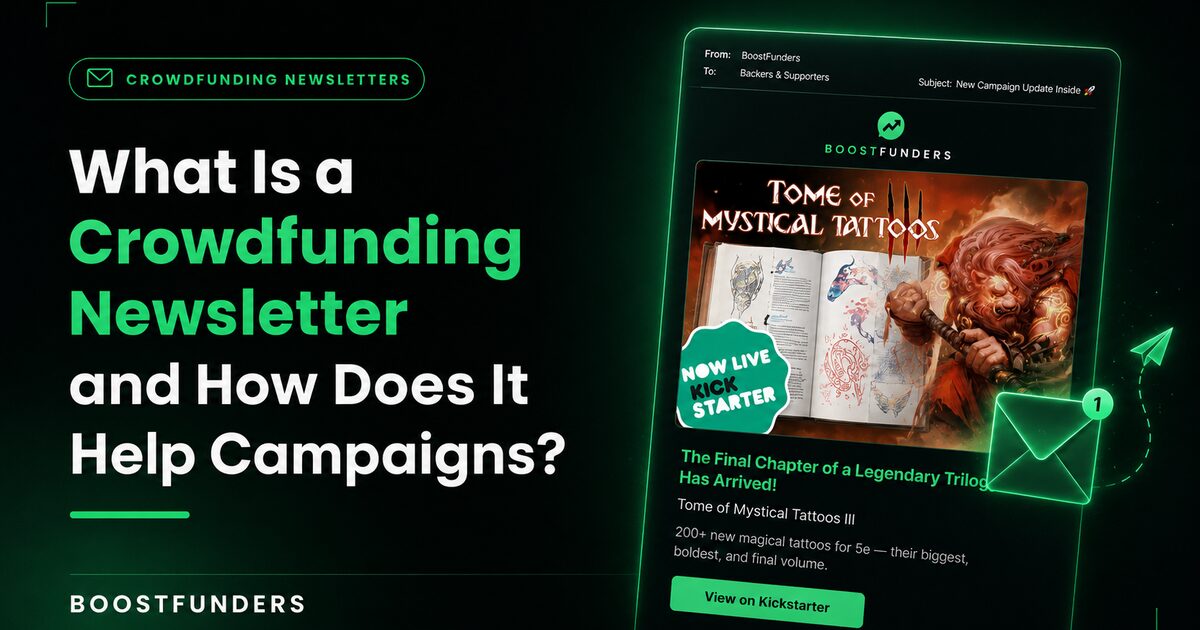
A crowdfunding newsletter is an email publication, usually sent on a regular schedule (weekly or a few times a month), built around a single purpose: introducing subscribers to new crowdfunding campaigns worth checking out.
The subscribers are the key part. People sign up for these newsletters because they specifically enjoy discovering and backing new projects — tabletop games, gadgets, design products, apps, causes. They're not a random email list. They're a self-selected audience of people who already like the idea of pledging to something new.
"Think of it less like an ad, and more like a curated recommendation from a source the reader already trusts to point them toward projects worth their money."
Newsletter operators build and maintain these subscriber lists over time — often years — through their own content, community building, and word of mouth within the crowdfunding space. When you book a placement, you're essentially renting access to an audience someone else spent a long time building. This external-traffic layer matters more than it might seem: Kickstarter's own platform statistics show that a large share of successfully funded projects rely on traffic the creator brought in themselves, not just visitors browsing the site.
How a Newsletter Placement Actually Works
The mechanics are simple, but it helps to see the full sequence from submission to results.
-
1You submit your campaignYou provide your campaign link, a short pitch, and sometimes assets like images or a video link, through the newsletter's submission form.
-
2The team reviews itReputable newsletters review every submission before accepting it — checking that the campaign is legitimate, well-presented, and a fit for their audience. This review step is actually a good sign; it means the newsletter protects its subscriber trust rather than accepting every paid submission.
-
3They write the featureAn editor writes a short piece introducing your campaign — what it is, why it's interesting, and a clear link to back it. This is usually done in the newsletter's own voice, not just a copy-pasted campaign description.
-
4It goes out on the scheduled sendYour feature is included in the next edition, sent to the subscriber list on the agreed date. This is when you'll see a traffic spike on your campaign dashboard, usually starting within the first hour or two of the send.
-
5You track the resultsMost services provide a tracked link so you can see exactly how much traffic, and ideally how many pledges, came directly from the newsletter send.
Why Newsletter Traffic Converts Better
The core reason comes down to audience intent, and it's worth understanding clearly because it explains almost everything else about how this channel performs compared to other promotion options.
When someone scrolls past a Facebook ad, they weren't looking for a crowdfunding campaign — the ad interrupted whatever they were actually doing. When someone opens a crowdfunding newsletter, they opened it because they wanted to see what new campaigns exist. The intent is already there before your campaign ever enters the picture.
| Newsletter Traffic | Cold Paid Traffic | |
|---|---|---|
| Audience intent | Actively seeking new campaigns | Interrupted mid-scroll |
| Trust level | Editorial endorsement | Labeled "Sponsored" |
| Typical CTR Higher | 8–18% | 0.9–2.5% |
| Setup required | Submission and review only | Creative, targeting, testing |
This doesn't mean newsletter promotion is automatically "better" in every sense — it has a fixed audience size, so it can't scale the way paid ads can. For a full breakdown of how the two channels compare on cost and conversion, and exactly when to lean on each one, see our guide on Kickstarter newsletter promotion versus paid ads.
The Different Types of Newsletter Placements
Not every placement is the same, and pricing reflects how much exclusive attention your campaign gets in the send. At Boostfunders, we offer three tiers:
- Shared Feature ($250) — your campaign appears alongside two or three other projects in a single edition. Lower cost, shared attention. A good entry point.
- Dedicated Feature ($500) — a standalone feature written entirely about your campaign, still sent to the regular list. Your project gets the full spotlight in that edition.
- Solo Send ($850) — an entirely separate email, sent only about your campaign, to the full subscriber base. Maximum reach and attention, used when a campaign needs a serious push at a critical moment.
Most crowdfunding newsletters structure their pricing similarly — the more exclusive the placement, the higher the cost, because you're competing for less shared attention within the send.
When in Your Campaign to Use a Newsletter Placement
Newsletter promotion isn't limited to one moment in a campaign's life. It's useful at several different points, for different reasons.
Launch week
A newsletter send timed to your first few days can add to your launch-week momentum, which matters because Kickstarter's own discovery algorithm tends to favor campaigns with strong early velocity.
The mid-campaign slump
Almost every campaign sees pledges slow down significantly after the first week, once the creator's personal network has been exhausted. A newsletter placement here brings in a fresh wave of backers who were never part of your existing network to begin with — we cover this exact scenario in detail in how to promote a Kickstarter campaign that's live but not getting backers.
The final 72 hours
A newsletter send emphasizing the closing deadline taps into genuine urgency — people who were on the fence often decide when they see a real countdown, and newsletter subscribers already primed to back projects respond well to this framing.
What to Look for in a Crowdfunding Newsletter Before Booking
Not every newsletter is worth paying for, and the space has enough variation in quality that it's worth checking a few things before you commit budget.
- Real subscriber numbers — ask for their list size and, ideally, average open rates. A newsletter that won't share basic performance data is a red flag.
- Editorial review process — a newsletter that accepts every paid submission without any review has likely trained its subscribers to ignore sponsored content, which hurts your results.
- Relevant audience — a general "crowdfunding" newsletter is fine for most product categories, but if your project is highly niche (a specific hobby, a professional tool), check whether the list actually includes people who'd care.
- Tracked reporting — you should get a trackable link and a clear report of clicks and, where possible, pledges generated from the send.
- Some form of performance accountability — services that offer any kind of ROI protection or performance guarantee have more skin in the game than ones that just take payment and send.
- Genuinely opted-in subscribers — a purchased or scraped email list is a different thing entirely from a real newsletter audience, and using one can run afoul of the FTC's CAN-SPAM Act requirements around consent-based email marketing.
If a newsletter service guarantees an exact number of backers for a fixed price, be cautious — no legitimate service can promise a specific pledge outcome, since that depends heavily on your campaign page and product itself. What they can reasonably guarantee is reach, tracked traffic, and a fair review of performance.
Does This Only Work for Kickstarter?
No — crowdfunding newsletters typically cover Kickstarter, Indiegogo, and increasingly equity platforms like Wefunder, since the core audience (people who like discovering and backing new projects) overlaps across all of them. If you're weighing equity crowdfunding as an option alongside or instead of a rewards-based campaign, our guide to how Wefunder works is a useful next read.
Conclusion
A crowdfunding newsletter is, at its core, a way to borrow access to an audience that already wants what you're offering: people who like discovering and backing new campaigns. That's what separates it from cold traffic sources like paid ads — the interest exists before your campaign ever shows up in their inbox.
It's not the only channel a campaign needs, and it has a real ceiling — a newsletter list is only so big, and it can't run every single day the way ads can. But for launch week, the mid-campaign slump, or the final urgency push, it's one of the most reliable ways to bring in backers who are actually ready to pledge, not just curious visitors passing through.
If you're planning your next campaign's marketing budget, a newsletter placement is worth treating as a core channel, not an afterthought — right alongside paid ads and your own community outreach.