
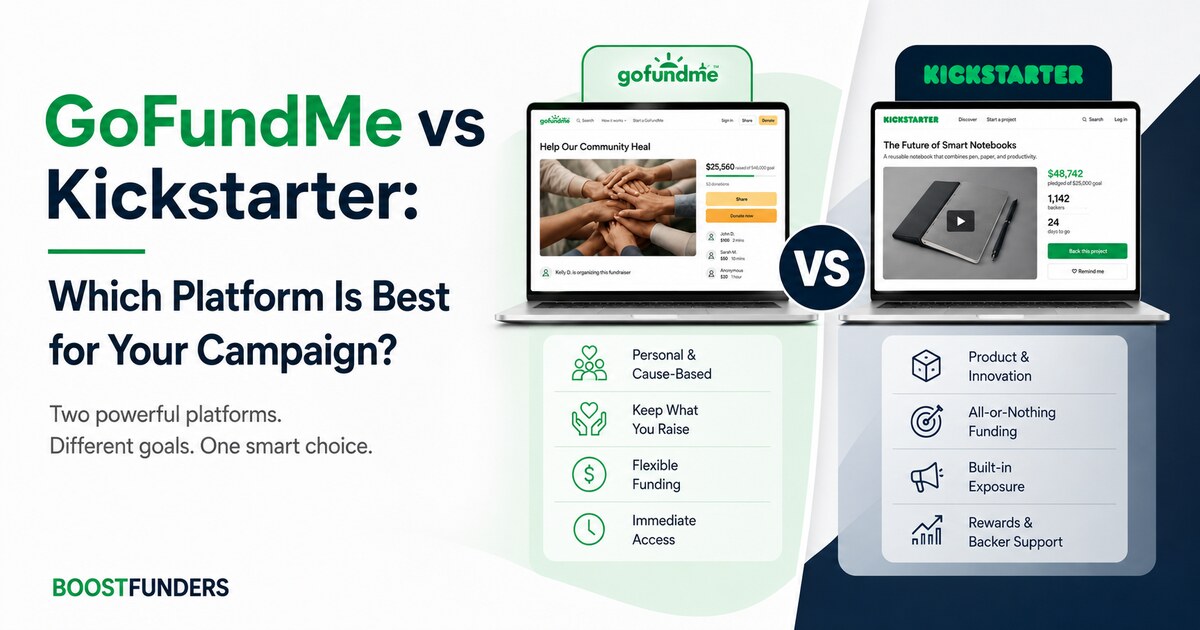
Key Takeaways
- GoFundMe is best for donation-based fundraising, personal causes, community support, emergencies, and charity-related campaigns
- Kickstarter is best for creative projects, product launches, games, films, books, technology, design, and reward-based campaigns
- Kickstarter uses an all-or-nothing model: if the project does not reach its funding goal, backers are not charged and the creator receives no funds
- GoFundMe does not require the organizer to hit a fundraising goal before receiving money raised
- GoFundMe donors usually give because they care about the person, cause, urgency, or social need
- Kickstarter backers usually pledge because they want to help create something new and receive a reward or early access
- The best platform depends less on popularity and more on campaign intent: donation, product, reward, creative project, nonprofit, or emergency support
- Marketing for GoFundMe depends heavily on personal networks and emotional storytelling; marketing for Kickstarter depends heavily on pre-launch audience building and campaign page conversion
Choosing between GoFundMe and Kickstarter sounds simple until you are the person who actually has to launch the campaign. Both platforms help people raise money online, but they are built for very different types of goals.
GoFundMe is strongest when the campaign is built around help, need, urgency, community support, charity, medical expenses, memorials, emergencies, nonprofit causes, education, or personal fundraising. Kickstarter is strongest when the campaign is built around bringing a creative project to life — such as a product, game, book, film, design project, technology idea, or artistic work.
This difference matters because the wrong platform can damage your campaign before your marketing even begins. A creator launching a new product on GoFundMe may struggle because donors do not visit GoFundMe expecting to pre-order innovation. A family raising emergency funds on Kickstarter will likely struggle because Kickstarter is not designed for personal causes or open-ended donations.
This guide explains the real difference between GoFundMe and Kickstarter, when to choose each platform, what fees and funding rules to consider, how marketing strategy changes for each, and how Boostfunders can help you promote the right campaign on the right platform.
Choose GoFundMe if your campaign is donation-based, personal, charitable, emergency-driven, or community support focused. Choose Kickstarter if you are launching a creative project, physical product, game, film, book, or design idea and can offer backers rewards.
GoFundMe vs Kickstarter At a Glance
| Feature | GoFundMe | Kickstarter |
|---|---|---|
| Best for | Donations, emergencies, personal causes, charity, medical, memorial, community fundraising | Creative projects, products, games, books, films, design, technology, art |
| Funding model | Keep what you raise; goal does not need to be met before receiving funds | All-or-nothing; funds collect only if the goal is reached |
| What supporters expect | To help, donate, support a person or cause | To back a creative project and receive rewards |
| Rewards/perks | Usually optional or not expected | Core part of the campaign |
| Deadline pressure | Flexible; urgency comes from the cause/story | Built-in deadline and funding goal |
| Main trust factor | Personal credibility, transparency, proof of need, updates | Product promise, creator credibility, prototype, rewards, timeline |
| Best marketing channel | Personal network, social sharing, email, community groups, local press | Email list, pre-launch page, ads, PR, influencers, Kickstarter audience |
| Good fit for businesses? | Only if donation or community support makes sense | Yes, if launching a creative product or project |
| Not ideal for Watch out | Pre-selling complex products with reward tiers and production timelines | Medical bills, personal emergencies, charity-only fundraising, open-ended donations |
What Is GoFundMe?
GoFundMe is a donation-based crowdfunding platform built around fundraising for people, causes, communities, nonprofits, emergencies, and personal needs. The platform walks organizers through setting up a fundraiser, adding a photo or video, writing a campaign description, sharing the fundraiser, posting updates, thanking donors, and setting up bank transfers.
GoFundMe explains that organizers can start by answering a few setup questions, adding a photo or video, writing a description that explains who or what they are raising money for and how funds will be used, then sharing the fundraiser link through close friends, family, social media, text, email, team members, and daily updates.
The biggest advantage of GoFundMe is emotional accessibility. People understand the platform quickly. A donor does not need to understand a product roadmap, manufacturing plan, reward tier, or business model. They simply need to understand the need and trust the organizer. This makes GoFundMe especially strong for campaigns involving medical expenses, memorials, disaster relief, education, community support, nonprofit giving, animals, emergencies, and personal hardship.
What Is Kickstarter?
Kickstarter is a reward-based crowdfunding platform designed to help creative projects come to life. It is not a general donation site and it is not a store. Kickstarter itself explains that backers support a creative process, and creators offer rewards such as limited editions, copies of the work being produced, or special experiences.
A Kickstarter project must have a clear goal and a defined outcome. This is why the platform works well for categories like games, publishing, design, film, music, comics, food, technology, and art. A creator is expected to show what they are making, why it matters, how much money is needed, what backers receive, and when rewards are expected to be delivered.
Kickstarter is often the better platform when your campaign is not about asking for help, but about inviting people to help make something new. Backers are not simply giving money — they are joining the creation of a project. Kickstarter Support defines a project as a finite work with a clear goal and explains that funding is all-or-nothing.
The Core Difference: Donations vs Rewards
The simplest way to understand the difference is this: GoFundMe is built around donation intent, while Kickstarter is built around project creation intent.
On GoFundMe, the campaign is usually about need. The supporter asks: Who needs help? Why now? Can I trust this person? How will the money be used? Does my donation make a difference?
On Kickstarter, the campaign is usually about creation. The backer asks: What is being made? Is the product or project exciting? Can the creator deliver? Are the rewards worth it? Is there enough momentum to make this real?
This changes everything — your headline, campaign video, story structure, CTA, images, updates, and promotional strategy.
| Question | GoFundMe Answer | Kickstarter Answer |
|---|---|---|
| Why do people give? | To help a person, cause, family, nonprofit, or community need | To support a creative project and receive a reward |
| What should the page emphasize? | Urgency, trust, need, transparency, impact | Product/project value, reward tiers, creator credibility, delivery plan |
| What is the emotional trigger? | Empathy and community support | Excitement, innovation, belonging, early access |
| What is the CTA? | Donate or share | Back this project / choose a reward |
"GoFundMe donors ask 'who needs help and can I trust them?' Kickstarter backers ask 'what's being made and is it worth it?' Those are fundamentally different questions to answer on your campaign page."
Funding Model: Keep-What-You-Raise vs All-or-Nothing
GoFundMe: Flexible fundraising
GoFundMe is flexible because organizers do not need to hit their goal before receiving funds. This is important when money is needed urgently, such as for medical bills, rent, funeral expenses, emergency travel, disaster relief, or community support. This flexibility reduces pressure — even if a GoFundMe campaign raises only part of the goal, the organizer can still use the funds to help with the stated need.
GoFundMe states that organizers can set up bank transfers and do not need to hit their fundraising goal to receive money raised (source).
Kickstarter: All-or-nothing funding
Kickstarter is different. If a Kickstarter campaign does not reach its funding goal by the deadline, backers are not charged and the creator receives no money. This model creates urgency and gives backers confidence that the creator will only proceed if enough money is available to deliver the project.
For product creators, this can be a major advantage. It creates a clear funding target, a deadline, and a reason for early backers to help spread the campaign. Kickstarter explains that all-or-nothing funding protects creators and backers while creating urgency (source).
Fees and Costs
Fees should not be the only reason you choose a platform, but they do affect your budget and campaign planning. Always confirm the latest fees on the official platform pages before launch because pricing can vary by country, payment method, and fundraiser type.
For United States individual/business fundraisers, GoFundMe currently lists no fee to create or manage a fundraiser, optional donor contributions to GoFundMe, and a transaction fee of 2.9% + $0.30 per donation. For certified charity fundraisers, GoFundMe lists a different transaction fee in the United States. GoFundMe also notes that international transaction and conversion fees may apply.
Kickstarter states that if a project is successfully funded, it collects a 5% fee from the funds collected for creators, and Stripe collects a payment processing fee of roughly 3-5%. If a project does not reach its funding goal, no fees are collected.
| Cost Area | GoFundMe | Kickstarter |
|---|---|---|
| Create campaign | No fee to create or manage a fundraiser in listed pricing | No fee unless project is successfully funded |
| Platform fee | No required platform fee for individual/business fundraisers listed in U.S. pricing; optional donor tips | 5% platform fee on successfully funded projects |
| Payment processing | U.S. individual/business pricing lists 2.9% + $0.30 per donation | Roughly 3–5% via Stripe |
| If goal is not reached | Funds raised can still be received | No money collected and no fees charged |
External references: GoFundMe pricing and Kickstarter fees.
Campaign Types: Which Platform Fits Your Goal?
Choose GoFundMe if it's about support or need
- Medical bills or health-related support
- Funeral or memorial fundraising
- Disaster or emergency relief
- Education expenses
- Community support and family hardship
- Animal rescue or care
- Charity or nonprofit fundraising
- Local causes
Choose Kickstarter if it's about making something new
- Consumer products
- Board games and video games
- Books and publishing
- Films and documentaries
- Music and creative albums
- Design projects and technology prototypes
- Comics and art projects
- Food and beverage products with a creative angle
GoFundMe is strongest when the story is personal, urgent, transparent, and easy to share. The campaign should make it clear who is being helped, why the money is needed now, how funds will be used, and how donors can trust the organizer. Kickstarter is strongest when you can show a clear project, a strong creative vision, a reward structure, a prototype or proof of concept, and a realistic delivery plan.
Audience and Donor Psychology
The audience mindset on each platform is different. This is why the same campaign copy cannot simply be copied from one platform to the other.
GoFundMe donors usually respond to empathy, urgency, relationship, proof of need, and community trust. They often give because someone they know shared the fundraiser, because the story feels real, or because the cause matters to them personally.
Kickstarter backers usually respond to novelty, reward value, credibility, scarcity, early access, design quality, campaign momentum, and community excitement. They want to feel part of something new before it becomes available everywhere else.
In practical marketing terms, GoFundMe campaigns need stronger emotional clarity, while Kickstarter campaigns need stronger product clarity.
Marketing Strategy for GoFundMe
A GoFundMe campaign usually does not grow because it was simply published. It grows because people share it. The campaign must be easy to understand, emotionally clear, and trustworthy enough for supporters to send it to others.
The strongest GoFundMe marketing strategy starts with the closest network before moving outward. Family, friends, colleagues, church/community groups, local organizations, social media contacts, and email connections are usually the first layer. If they respond, the campaign gains early proof and credibility.
- 1Write a direct storyExplain who the fundraiser is for, what happened, why the need is urgent, how funds will be used, and how supporters can help.
- 2Use a real photo or videoAuthentic visuals build more trust than generic graphics.
- 3Start with close contactsAsk people who already know you to donate, comment, and share before broad public promotion.
- 4Post updates oftenUpdates show progress, transparency, gratitude, and continuing need.
- 5Make sharing easyGive supporters a short caption they can copy and paste.
- 6Use local press and community groupsNeighborhood pages, schools, churches, nonprofits, clubs, and local media can help when the story is community-relevant.
- 7Thank donors publicly when appropriateGratitude encourages repeat sharing and builds trust.
- 8Do not disappearA silent campaign loses momentum quickly.
For a deeper walkthrough of organic GoFundMe promotion, see our full guide on how to promote your GoFundMe campaign online.
Marketing Strategy for Kickstarter
Kickstarter marketing works differently because the campaign has a deadline, funding goal, reward tiers, and an algorithmic discovery environment. The first few days matter heavily because early backer momentum can influence visibility, social proof, and confidence.
The biggest mistake first-time creators make is launching before they have an audience. Kickstarter is not a replacement for marketing. It is a platform that can amplify momentum when the campaign already has one.
- 1Build a pre-launch email list before launchEmail subscribers are more controllable than social followers.
- 2Create a Kickstarter pre-launch pageCollect followers and warm them before launch day.
- 3Validate your positioningMake sure people understand the product or project in seconds.
- 4Use strong visuals and videoKickstarter backers need to see what they are helping create.
- 5Design reward tiers carefullyRewards should feel clear, valuable, and easy to choose.
- 6Drive traffic in the first 48 hoursEmail, social, PR, influencer outreach, and communities should all be ready before launch.
- 7Use updates and stretch goals strategicallyKeep backers engaged and give them reasons to share.
- 8Retarget interested visitorsPeople often need more than one touchpoint before backing.
For the complete pre-launch to post-campaign playbook, see our guide on best Kickstarter marketing strategies for first-time creators, and our Kickstarter pre-launch marketing guide for how to build momentum before you go live.
Common Mistakes to Avoid
| Mistake | Why It Hurts | Better Approach |
|---|---|---|
| Using GoFundMe for a product launch | Donors are usually not there to pre-order products | Use Kickstarter or Indiegogo for reward-based product launches |
| Using Kickstarter for personal hardship | Kickstarter is for creative projects, not general personal causes | Use GoFundMe or another donation-based platform |
| Launching without an audience | No early traffic means weak momentum | Build email, community, and outreach before launch |
| Weak story | People do not understand why they should care | Explain who, why, what happened, what is being made, and how funds are used |
| No updates | Supporters lose trust and attention | Post campaign updates regularly |
| Unclear money use | Donors/backers may hesitate | Break down the budget and explain impact |
| Generic visuals | The campaign feels less credible | Use real photos, product visuals, founder video, or clear mockups |
| Wrong CTA | People do not know what to do next | Use clear donation/backing/share CTAs |
Decision Checklist
Use this checklist before choosing a platform:
- Purpose: you need donations for a cause, emergency, person, community, or nonprofit
- Reward expectation: supporters usually get nothing back; they donate to help
- Funding requirement: partial funds still help — you don't need all the money before proceeding
- Deadline: not always central to the campaign
- Story: need, impact, trust, urgency
- Supporter is called: a donor
- Purpose: you are creating a defined project or product
- Reward expectation: supporters receive rewards or early access
- Funding requirement: you need a minimum budget to deliver — all-or-nothing
- Deadline: yes, the deadline creates urgency
- Story: creation, innovation, rewards, delivery
- Supporter is called: a backer
How Boostfunders Helps
Boostfunders helps creators, founders, nonprofits, and campaign owners choose the right crowdfunding platform and build a marketing strategy around that platform.
For GoFundMe and donation-based campaigns, the strategy usually focuses on emotional storytelling, donor trust, community sharing, social media outreach, local visibility, email promotion, and consistent updates. For Kickstarter campaigns, the strategy usually focuses on pre-launch audience building, email list growth, Kickstarter followers, campaign page optimization, reward structure, launch-day momentum, paid ads, PR, influencer outreach, and live campaign optimization.
The platform matters. But the platform alone does not create momentum. Your campaign needs the right story, the right audience, the right content, and the right promotion plan.
Conclusion
GoFundMe and Kickstarter are both powerful crowdfunding platforms, but they are not interchangeable. Choose GoFundMe when your campaign is donation-based, urgent, personal, charitable, community-driven, or built around helping someone or something directly. Choose Kickstarter when your campaign is a creative project, product launch, game, film, book, design idea, or innovation that can offer backers rewards.
The best platform is not the one with the biggest name. It is the one that matches your campaign intent and supporter psychology. If people are donating because they care, GoFundMe may be the better fit. If people are backing because they want to help bring a project to life and receive something in return, Kickstarter is likely the stronger option.
Once you choose the right platform, the next step is marketing — because even the right platform will not perform without a strong story, audience, trust, and campaign momentum. Need help choosing or promoting the right crowdfunding platform? Submit your project to Boostfunders and our team can review your campaign direction within 2 hours.